The Top 20 Dry Van Carriers Every Freight Broker Should Know
A field guide to 20 major North American carrier networks—and how brokers can use carrier knowledge to find stronger lanes, better capacity, and new shipper opportunities.
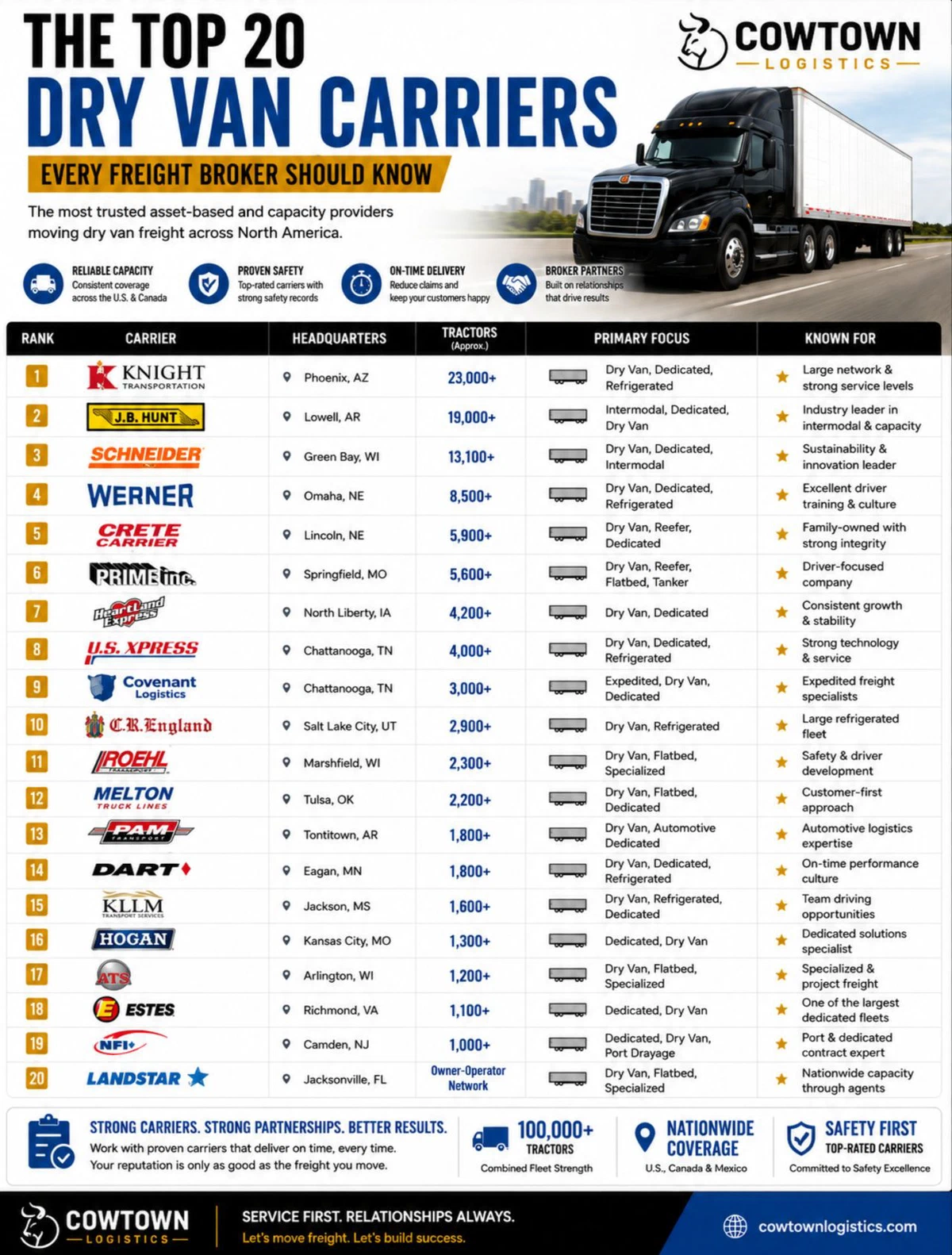
Colby Baskin's one-page guide to 20 major North American dry van carriers.
TL;DR
Carrier-first freight prospecting reverses the usual order. Instead of winning a shipper’s load and then searching for a truck, learn where a dependable carrier already runs, what freight it wants, and where it needs better utilization. Then prospect shippers whose freight fits those lanes. The result can be a more credible sales conversation and a stronger plan for covering the freight after it is won.
Table Of Contents
Most freight sales conversations begin with the shipper. What are you moving? Where is it going? How often does it ship? What are you paying today?
That is a reasonable place to start, but it is not the only place.
A carrier-first approach begins on the other side of the market. You learn where a dependable carrier has trucks, which lanes it runs well, what equipment it operates, and what freight would improve its week. Then you look for shippers whose needs match that capacity.
This does not replace shipper prospecting. It gives it direction.
In a typical transaction, the carrier search happens after the broker receives the load. The origin, destination, appointment, commodity, and rate are already defined. The broker’s job is to find a truck that can make the plan work.
Carrier-first prospecting moves part of that work upstream.
Suppose a reliable dry van carrier
regularly unloads near Dallas on Tuesday mornings and wants outbound freight toward Kansas City, St. Louis, or Chicago. That information gives a broker a much more specific prospecting target than “companies that ship freight.” The broker can look for manufacturers, distributors, and warehouses
with recurring outbound volume that fits the carrier’s equipment and operating schedule.
Now the sales conversation is grounded in an actual capacity pattern:
The equipment is known.
The origin market is known.
The carrier’s preferred direction is known.
The likely pickup window is known.
The broker has a reason to believe the freight can be covered consistently.
That is a stronger starting point than selling a broad promise and figuring out capacity later.
Understanding those differences helps a broker see that a carrier is not interchangeable with every other carrier that owns the same trailer type
.
Colby Baskin’s one-page guide to 20 major North American dry van carriers. Fleet counts, ownership, service mix, and operating networks change, so confirm current information directly with the carrier before making a transportation decision.
The carrier guide is a useful starting point for learning the market, but it is not a carrier-selection scorecard. Fleet counts, ownership, service mix, and operating networks change. A large tractor count does not tell you whether a carrier has the right truck in the right market on the day your customer needs it. It also does not replace current authority, insurance, identity, safety, equipment, or service checks.
The 20 Carriers in Colby’s Guide
The following snapshot translates the one-pager into searchable text. Except where noted, tractor counts are approximate figures shown in the guide rather than real-time capacity figures.
Carrier networks evolve through acquisitions, divestitures, dedicated contracts, owner-operator relationships, and changes in equipment. Use the list to identify companies worth learning about, then verify current information with the carrier.
Use a list like this to ask better questions:
Which markets does this carrier serve with company trucks, dedicated assets, agents, or owner-operators?
Which freight types and customer commitments shape its network?
Does its equipment and operating model fit the shipment?
Is the carrier interested in broker freight on this lane?
Who should be contacted about recurring opportunities?
The value is not memorizing a ranking. The value is learning how different carrier networks work.
Why Small and Mid-Sized Fleets Matter
The largest carrier is not automatically the best opportunity for a broker.
Many large fleets already have contract freight, dedicated lanes, established customer relationships, and internal systems built around their network. They may still work with brokers, but that does not mean every lane or load is a fit.
Small and mid-sized fleets can offer a different kind of opportunity. A ten-truck carrier may care deeply about a repeat lane that barely registers inside a national fleet. A regional carrier may know the facilities, appointment patterns, weather, and rate behavior in its market better than a carrier operating everywhere. An owner who answers the phone may also be able to make a clear decision faster.
Those relationships become valuable when they are built around mutual fit rather than a one-time transaction.
Cowtown works with carriers through its carrier network
across dry van, flatbed
, reefer
, expedited, and specialized freight
. The useful question is not “How big is the fleet?” It is “Can this carrier serve this freight safely, legally, and consistently—and does the freight help its operation?”
Questions to Ask a Carrier Before Prospecting the Lane
The first conversation should go deeper than “Where are your trucks?”
Ask questions that reveal how the operation actually works:
What equipment do you operate? Confirm trailer type, dimensions, weight limits, securement capabilities, and any specialized equipment.
Where do your trucks regularly originate? A headquarters address does not tell you where capacity is available.
Which destinations do you prefer? Learn the outbound lanes the carrier wants as well as the markets it avoids.
What does a good weekly pattern look like? Pickup days, reload timing, home time, and customer commitments can matter as much as mileage.
What freight do you want to haul? Ask about commodities
, handling requirements, driver-assist expectations, and exclusions.
Where do you need help with utilization? A weak backhaul or recurring empty move may point directly to a shipper opportunity.
What would make the relationship worth keeping? Rate matters, but so do accurate details, reasonable facilities, fast decisions, communication, and payment.
Write the answers down. A carrier conversation only becomes a prospecting advantage when the information can be matched to a real shipper profile.
Turn Carrier Knowledge Into a Shipper List
Once the lane and freight profile are clear, build the shipper search around that operating need.
Start with the origin radius. Identify industrial areas, manufacturers, distributors, import facilities, food producers, building-material suppliers, or other businesses likely to ship the right commodity in the right equipment. Then narrow the list by destination markets, shipment frequency, pickup schedule, and facility requirements.
For example, a carrier looking for recurring Dallas-to-Midwest dry van freight gives the broker several filters:
Pickup within the carrier’s normal Dallas-area positioning
Palletized or boxed freight suitable for an enclosed trailer
Shipment days that fit the carrier’s reload schedule
Destinations inside the carrier’s preferred Midwest markets
Facilities the driver and equipment can serve
Enough consistency to reduce empty miles over time
That does not guarantee a customer. It does make the outreach more relevant.
Instead of saying, “We can handle anything,” the broker can say, “We are building dependable dry van capacity out of this market and want to understand your recurring Midwest lanes.” The second conversation gives the shipper a concrete reason to keep talking.
Carrier-First Does Not Mean Skipping Carrier Vetting
A promising lane is not a substitute for due diligence.
Before tendering freight, verify that the selected motor carrier is the company it claims to be and is qualified for the shipment. That includes current operating authority, insurance, safety information, equipment, contact details, and any commodity-specific requirements. Reconfirm the details when something changes.
A good relationship should make these checks easier, not less important.
This is also where an experienced freight broker
earns its place. The broker is not simply finding an available truck. The broker is matching a shipper’s requirements with a carrier’s real capabilities and coordinating the move from pickup through delivery.
Use Both Sides of the Market
There is no rule that every broker should start with the carrier or every broker should start with the shipper.
Some opportunities begin with a customer problem that needs capacity. Others begin with a strong carrier relationship and a lane that needs freight. The advantage comes from being able to work in both directions.
If you understand only the shipper, you may win freight you cannot cover well. If you understand only the carrier, you may have capacity without a customer. When you understand both, you can build a lane that works for the shipper, the carrier, and the broker.
That is the real point of carrier-first prospecting: solve a specific capacity problem, then go find the customer whose freight fits the solution.
Frequently Asked Questions
What is carrier-first freight prospecting?
Carrier-first freight prospecting starts by learning a carrier’s strongest lanes, equipment, schedule, and preferred freight. The broker then looks for shippers whose recurring loads fit that capacity instead of waiting to source a truck after winning the freight.
Should freight brokers prospect carriers or shippers first?
Most brokers need both. Shipper-first prospecting creates demand, while carrier-first prospecting creates a clearer capacity plan. The best starting point depends on the broker’s market, relationships, and the lanes where it can build a repeatable advantage.
Are large carriers always the best partners for freight brokers?
No. Large carriers can offer scale, broad networks, and specialized services, but small and mid-sized fleets may offer stronger communication, flexibility, and interest in consistent freight on specific lanes. The best partner is the carrier whose capabilities and operating preferences fit the load.
What should a broker learn before offering a carrier freight?
Ask about equipment, strongest origin markets, preferred destinations, weekly capacity, pickup schedule, commodity restrictions, driver needs, service expectations, and the lanes or backhauls the carrier wants to improve.
A compliance-first guide to the four permit types for oversized and overweight transport — what triggers each one, how state rules differ, and how to avoid the lead-time mistakes that strand loads on the shoulder.
Data center freight includes server racks, switchgear, generators, chillers, UPS systems, cable, and replacement parts that must arrive on schedule, intact, and visible from pickup to delivery.
Freight forwarders need a domestic partner that can cover urgent, high-value, white-glove, AOG, and specialized equipment moves without losing visibility or control of the customer relationship.
Read the story→
This website uses cookies to improve functionality and user experience. By continuing to use this site, you acknowledge our use of cookies. See our
privacy policy
.