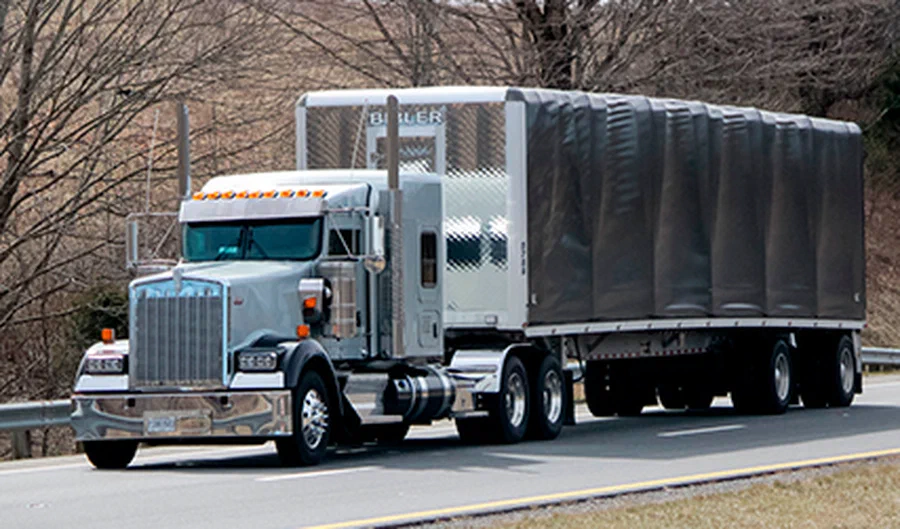
A Conestoga trailer is an open-deck trailer fitted with a rolling tarp system. “Conestoga truck” usually refers to the tractor and covered trailer together. The tarp and its supporting frame retract for loading, then close around the freight to help protect it from weather during transit. This combines flatbed-style access with a cover that does not need to be draped directly over the load.
A Conestoga trailer combines an open trailer deck with a rolling tarp supported by a movable frame. The system slides along tracks to expose the deck, giving the loading crew access from the side or above. Once the freight is secured, the cover closes around it for transit. The closed cover also hides cargo from outside view, adding privacy for high-value or sensitive freight.
The practical benefit is the combination: access similar to a standard flatbed trailer with added weather protection. A Conestoga is worth considering when a load needs both, rather than choosing equipment based on the commodity name alone.
Is a Conestoga a truck or a trailer?
In most freight conversations, “Conestoga truck” means a tractor pulling a Conestoga trailer. The tractor supplies the power; the trailer carries the freight; the rolling tarp system provides the cover. Conestoga does not describe a separate type of tractor.
Flatbeds are a common base for the system. Rolling tarp systems can also be fitted to drop-deck trailers and some straight trucks, as shown in Aero Industries’ Conestoga equipment brochure. A step-deck trailer provides a lower deck for taller freight.
Unlike a trailer with opening side curtains and a fixed roof, a Conestoga’s retracting tarp and frame provide access from above.
Conestoga trailer versus flatbed
Both Conestoga and standard flatbed trailers allow side loading and overhead crane loading when the deck is accessible. A standard flatbed has no fixed roof or walls, so freight is exposed unless a separate tarp or other protection is used.
A Conestoga trailer’s tarp moves on a frame instead of being laid directly over the freight. This keeps loose tarp material off sensitive surfaces or packaging. Straps, chains, and other securement hold the load in place independently of the cover.
The bows and tracks define the covered cargo space, which is smaller than the open deck.
Conestoga trailer versus dry van
A standard dry van is an enclosed trailer with fixed walls and a roof. It typically loads through rear doors, often at a dock. It can be a suitable choice for packaged or palletized freight that fits through those doors and can be handled from the rear.
A Conestoga trailer combines weather protection with side or overhead loading for shipments that cannot use rear-door access. Neither a standard dry van nor a standard Conestoga provides refrigeration. Weather protection and temperature control are separate requirements.
Conestoga, standard flatbed, and dry van comparison
On small screens, scroll the table horizontally to compare all three options.
Attribute
Conestoga
Standard flatbed
Standard dry van
Weather protection
Rolling tarp encloses the load when closed
Open deck; separate tarps or other protection needed if required
Fixed walls and roof enclose the load
Loading access
Side or overhead access with the system retracted; rear access depends on the configuration
Side, overhead, and rear access to the open deck
Typically through rear doors; fixed roof prevents overhead loading
Common use cases
Freight needing both weather protection and side or crane loading
Freight suited to an open deck, with a separate protection plan if needed
Packaged or palletized freight suited to rear loading
Fit considerations
Load must clear the frame and fit under the closed cover
Deck space, load support, and securement
Rear-door opening and interior space
Conestoga trailer types and typical dimensions
Conestoga trailers can use flatbed, step-deck, or double-drop configurations. These are typical planning figures from published freight-company references; actual trailers vary. Confirm the usable covered space and available payload for the assigned equipment before booking.
Usable interior width is often about 96–100 in, rather than the full 102-in deck width, because the tarp tracks occupy space along the sides. Bows and the retracted cover also take up cargo space.
Flatbed Conestoga trailers
Typical flatbed Conestoga trailer lengths are 48 ft and 53 ft. The covered height reference is approximately 8 ft, with payload of about 42,000–44,000 lb.
Step-deck Conestoga trailers
A step-deck configuration provides a lower main deck for taller freight. The two layouts below illustrate common deck-length arrangements; the payload range is a general planning reference for this equipment type.
Planning reference
48-foot step-deck Conestoga
53-foot step-deck Conestoga
Upper deck length
10 ft
10 ft
Lower deck length
38 ft
43 ft
Height above upper deck
Approximately 8 ft
Approximately 8 ft
Height above lower deck
Approximately 9 ft 2 in
Approximately 9 ft 8 in
Approximate payload
About 40,000–43,000 lb
About 40,000–43,000 lb
Double-drop Conestoga trailers
A double drop has a low central well for taller freight requiring a rolling cover. A 48-foot layout provides the following deck-length example:
Deck
Typical length
Front deck
9 ft
Central well
30 ft
Rear deck
9 ft
Double-drop planning reference
Typical figure
Covered height in the central well
Up to about 11 ft 6 in
Payload
Roughly 35,000–39,000 lb
Freight that may benefit from weather protection and side-loading access
Potential candidates include machinery on skids, crated equipment, and building products that need side loading or lifting from above. Lumber and wood shipments also benefit from covered equipment when their packaging or delivery specifications call for weather protection.
Choose equipment around the load’s protection, loading access, dimensions, and weight. For a shipment needing dedicated trailer space, review full truckload shipping alongside the equipment choice.
Loading and unloading considerations
Include these details in your equipment request:
Packaged dimensions and weight: Include the skid, crate, wrapping, and any projections.
Loading method at both ends: Identify forklift, crane, rear-dock, or other requirements and the equipment available at each site.
Room to operate: Allow space for the retracted tarp and frame, loading equipment, and the loading sequence.
Securement and surface protection: Identify approved tie-down points and any restrictions on contact with the freight or packaging.
Weather exposure during handling: The deck is exposed when the cover is open. Share any requirement to load or unload under shelter.
Delivery access and timing: Include appointments, access restrictions, and any delivery constraints in the request.
For rear loading, include the dock setup and required opening in the request.
When should a shipper consider a Conestoga trailer?
Consider a Conestoga trailer when the shipment needs weather protection during transit and side or crane loading makes a standard dry van unsuitable. It also keeps a loose tarp from resting directly on cargo with sensitive surfaces.
Choose a standard flatbed for freight that can travel on an open deck with an appropriate protection plan. Choose a dry van for packaged freight that fits inside and loads from the rear. The decision should follow the shipment’s access, protection, and fit requirements.
Flatbed Conestogas are typically 48 or 53 ft long, with about 8 ft of covered height and about 42,000–44,000 lb of payload. Usable interior width is often about 96–100 in. Step-deck examples have a 10-ft upper deck and a 38-ft or 43-ft lower deck, with about 9 ft 2 in or 9 ft 8 in of lower-deck clearance and about 40,000–43,000 lb of payload. Double-drop planning figures include a 30-ft well, up to about 11 ft 6 in of well clearance, and roughly 35,000–39,000 lb of payload. The dimensions section above compares these configurations.
Can a Conestoga be loaded from the side or by crane?
Yes. Retracting the tarp and frame exposes the deck for side loading or overhead crane loading. Include the loading method and site equipment in your shipment details.
Does a Conestoga replace freight packaging?
No. A rolling tarp helps protect freight from weather in transit, but the load still needs suitable packaging and securement. Loading or unloading with the cover open can expose freight to the weather.
A compliance-first guide to the four permit types for oversized and overweight transport — what triggers each one, how state rules differ, and how to avoid the lead-time mistakes that strand loads on the shoulder.
A field guide to 20 major North American carrier networks—and how brokers can use carrier knowledge to find stronger lanes, better capacity, and new shipper opportunities.
Data center freight includes server racks, switchgear, generators, chillers, UPS systems, cable, and replacement parts that must arrive on schedule, intact, and visible from pickup to delivery.
Read article→
This website uses cookies to improve functionality and user experience. By continuing to use this site, you acknowledge our use of cookies. See our
privacy policy.