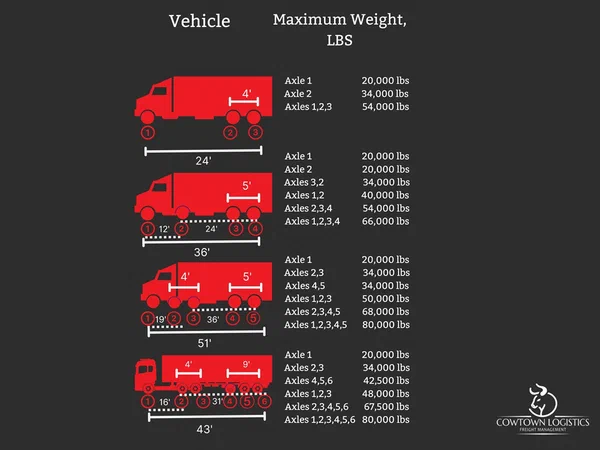
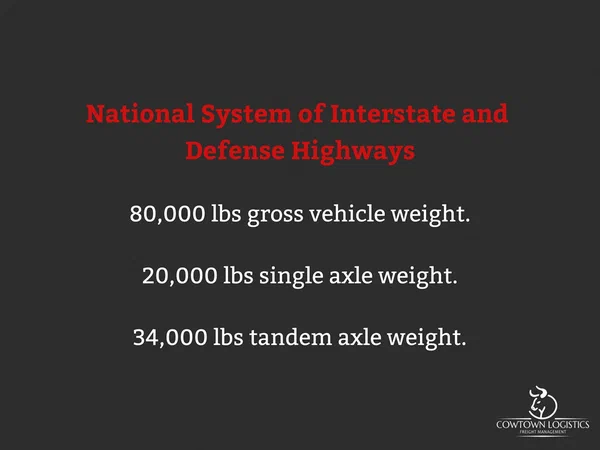
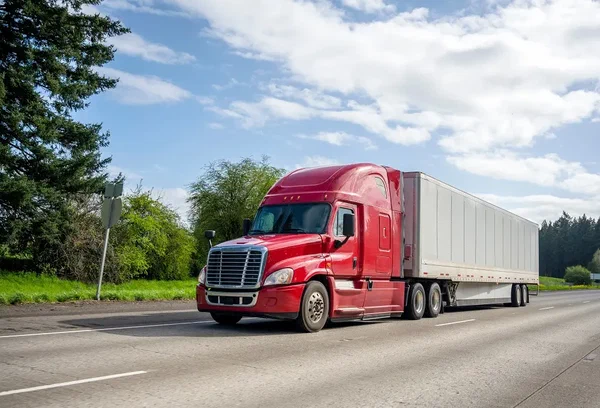
Federal law limits trucks on interstate highways to 80,000 lbs gross vehicle weight, 20,000 lbs per single axle, and 34,000 lbs per tandem axle group. Compliance depends on both total weight AND how that weight is distributed across axles - a load can be under the gross limit and still violate axle group rules. States may set stricter limits or require permits for loads exceeding federal thresholds, so route-by-route verification is required for heavy freight.
Table Of ContentsThe short answer: on the federal Interstate System, trucks are limited to 80,000 lbs gross vehicle weight, 20,000 lbs on a single axle, and 34,000 lbs on a tandem axle group — and compliance also depends on axle spacing under the Federal Bridge Formula. States can set their own limits and permit thresholds on top of that, so legal planning on any given route goes well beyond a single number.
Compliance is not just about total gross weight. Where the weight sits on the truck and trailer determines whether a load moves legally, requires a permit, or has to be reworked before it ever leaves the yard. For shippers and carriers handling heavy haul trucking services, axle weight planning protects drivers, infrastructure, schedules, and budgets.
This guide covers the federal baseline, the Bridge Formula, how axle groups work, and what state-by-state rules mean for heavy freight planning.
Heavy haul weight limits by state
What Are the Federal Axle Weight Limits for Trucks?
One of the first things to understand is that federal law sets a baseline for commercial truck weight on interstate routes. In general, a truck and trailer combination may run up to 80,000 pounds gross vehicle weight on the interstate system without a special overweight permit, assuming axle spacing and group weights are also compliant.
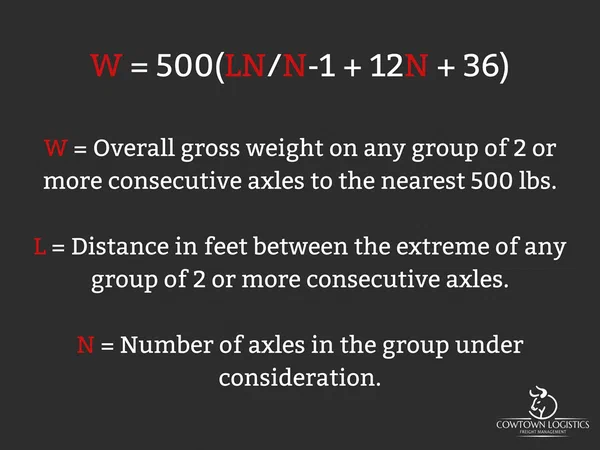
That is where the Federal Bridge Formula comes in. The formula looks at how weight is distributed across multiple axles and the distance between them so roads and bridges are not overloaded by concentrated force in a short span.
Federal Bridge Formula
W=500(LN/N-1 + 12N + 36)
Understanding axle weight limits and the federal bridge formula
For many shippers, the most practical takeaway is this: compliance depends on both total weight and weight distribution. Tandem groups, spacing, and overall configuration all matter.
In simple terms, the bridge formula helps prevent too much weight from being concentrated over too short a distance. That reduces stress on bridges, pavement, and the truck itself.
What Are Axle Groups?
Example of axle groups on a truck
Truck weight limits are also reviewed by axle group, not just by total vehicle weight. Common groupings include steer axles, drive tandems, and trailer tandems or other grouped trailer axles depending on the equipment configuration.
Each group has its own operational limits, and those limits can be affected by tire ratings, axle spacing, equipment design, and the route being used. That is why permit and routing teams review the full vehicle setup instead of relying on a single gross-weight number.
This is where heavy haul planning becomes more complex. States can set their own rules for non-divisible loads, permit thresholds, axle-group allowances, routing restrictions, curfews, and bridge-specific limitations.
That means “legal axle weight limits by state” is never just one chart or one number. The real answer depends on:
The equipment configuration
The number and spacing of axles
Whether the load is divisible or non-divisible
The origin, destination, and exact route
Permit conditions in each state involved
For routine legal freight, federal-style thresholds are the starting point. For overweight or oversized freight, the real planning work happens at the state permit level.
The table below gives a quick-reference view of published baseline limits and permit cues from several states that commonly come up in heavy-haul planning. It is a planning aid, not a substitute for permit review on the exact route.
Jurisdiction
Max gross (no permit)
Single axle
Tandem axle group
Notable state-specific rules
Federal Interstate
80,000 lbs
20,000 lbs
34,000 lbs
Bridge Formula applies to all axle groups; axle spacing determines the maximum allowable weight per group
California
80,000 lbs
20,000 lbs
34,000 lbs (axle group ≤ 8'6" between outer axles)
Larger axle groups governed by state chart; CA also imposes route restrictions and has strict permit review
Texas
80,000 lbs
20,000 lbs
34,000 lbs
Triple axle: 42,000 lbs; quad axle: 50,000 lbs; permit moves can use different axle-group tables
Florida
80,000 lbs
22,000 lbs (state roads)
44,000 lbs (state roads)
Florida allows higher axle weights on state roads vs. interstate; governed by Section 316.535; permits required above thresholds
Georgia
80,000 lbs
20,340 lbs
34,000 lbs
Overweight permits required above thresholds; bridge-specific weight limits common on older routes
Illinois
80,000 lbs
20,000 lbs
34,000 lbs
Illinois applies the Bridge Formula; Class III roads may have lower limits; seasonal weight restrictions apply
Ohio
80,000 lbs
20,000 lbs
34,000 lbs
Ohio uses a 10-axle formula for permitted loads; spring weight restrictions enforced on state routes
Pennsylvania
80,000 lbs
20,000 lbs
34,000 lbs
PA has some of the strictest weight enforcement in the northeast; Turnpike Authority applies separate permit rules
Tennessee
80,000 lbs
20,000 lbs
34,000 lbs
Overweight permits required above thresholds; time-of-travel restrictions on some permitted moves
Colorado
80,000 lbs
20,000 lbs
34,000 lbs
Mountain corridor restrictions apply; some passes have lower limits regardless of permit status
South Dakota
80,000 lbs
20,000 lbs
34,000 lbs
Other axle groups governed by Bridge Formula; tire-width checks required for permit moves
Oklahoma
80,000 lbs
20,000 lbs
34,000 lbs
Oklahoma Turnpike Authority permits are separate from state permits; both may be required
Kansas
80,000 lbs
20,000 lbs
34,000 lbs
Spring weight restrictions (Feb–May) on state roads reduce allowable weights by 10–15%
Missouri
80,000 lbs
20,000 lbs
34,000 lbs
MO applies the Bridge Formula; some rural routes have lower posted limits
New York
80,000 lbs
22,400 lbs
36,000 lbs
NY allows slightly higher axle weights than federal baseline; Thruway Authority applies additional permit requirements
Axle weight limits are not just paperwork. They protect road safety, infrastructure, and shipment reliability. Overloaded or poorly distributed freight can create serious problems:
Increased stopping distance and reduced control
Tire, suspension, or braking issues under excess load
Faster wear on bridges and pavement
Expensive fines, rework, delays, or forced unloading when a load is out of compliance
How Do You Stay Compliant with Axle Weight Limits?
Compliance starts before dispatch. For heavy or specialized freight, axle planning should be part of quoting, trailer selection, and route review rather than an afterthought.
#1. Knowledge of Truck Weight Limits
Every load planner should understand the difference between gross vehicle weight, axle weight, and axle-group distribution. It is not enough to know that a trailer can “handle the load” in general terms.
The usable payload depends on the tractor, trailer, axle setup, and the route rules involved. A legal load on one trailer or in one state may need different planning somewhere else.
#2. Regular Weigh-Ins
Scale tickets and regular weigh-ins are one of the fastest ways to catch an issue before it becomes a roadside problem. Certified scales help confirm both total weight and axle distribution after loading.
#3. Strategic Load Distribution
Tips for compliance with axle weight limits
Balanced load distribution is essential. The same piece of freight can create very different axle readings depending on where it sits on the deck, how it is secured, and what trailer configuration is used.
For oversized or dense freight, experienced planners often adjust trailer choice, deck position, and securement strategy together to reach a workable axle layout.
#4. Securing Permits
When a shipment exceeds legal thresholds, permits are essential. Overweight permits can come with route approvals, travel-time restrictions, escort requirements, and bridge-specific instructions that have to be followed exactly.
For multi-state moves, teams should review permits state by state instead of assuming one plan will carry across the whole route.
Axle Weight Limits FAQ
What are the federal axle weight limits for trucks?
Common federal baseline limits on the Interstate System include 80,000 pounds gross vehicle weight, 20,000 pounds on a single axle, and 34,000 pounds on a tandem axle group. Axle spacing and bridge formula rules still apply, so those numbers are not the only compliance factor.
What is the maximum legal weight for a semi truck?
On the federal Interstate System, the maximum gross vehicle weight without a special permit is 80,000 pounds. That limit also requires compliance with the Federal Bridge Formula. State roads and local routes may have lower limits, and some states — like Florida and New York — allow higher axle weights on certain state highways than the federal baseline.
What is the Federal Bridge Formula?
The Federal Bridge Formula (W = 500 × [LN/N−1 + 12N + 36]) sets the maximum weight allowed on any group of axles based on the number of axles (N) and the distance in feet between the outermost axles (L). A truck can be under the 80,000-pound gross limit and still violate the formula if axle spacing is too short for the load being carried.
Can a truck be legal on gross weight but illegal on axle weight?
Yes. A truck can be under the total gross weight limit and still violate axle rules if too much weight is concentrated on one axle or axle group. That is why scale tickets and load distribution matter so much.
What happens if a truck is overweight?
Consequences include roadside fines (many states use a per-pound-over structure that makes heavy violations very expensive), out-of-service orders, required unloading before the truck can continue, and permit violations. Repeat offenses can affect a carrier’s safety rating and operating authority.
Do axle weight limits apply on all roads?
No. Federal axle weight limits apply to the Interstate Highway System. State and local roads can impose lower weight limits, especially on older bridges and rural routes. Many states also enforce seasonal spring weight restrictions when pavement is most vulnerable to damage, temporarily reducing allowable weights by 10–20%.
Why do axle weight limits vary by state?
States can set their own permit thresholds, route restrictions, and rules for non-divisible loads. As a result, axle planning often depends on the exact route, equipment setup, and permit conditions in each state involved.
Conclusion
Legal axle weight limits are really about distribution, configuration, and route planning as much as total pounds. Federal rules provide the baseline, but state permit requirements often determine what is actually workable for heavy freight in the field.
If your shipment needs careful trailer selection, route planning, or overweight coordination, Cowtown Logistics can help build a compliant plan before the freight moves. You can contact us today to talk through the load.
A compliance-first guide to the four permit types for oversized and overweight transport — what triggers each one, how state rules differ, and how to avoid the lead-time mistakes that strand loads on the shoulder.
A field guide to 20 major North American carrier networks—and how brokers can use carrier knowledge to find stronger lanes, better capacity, and new shipper opportunities.
Data center freight includes server racks, switchgear, generators, chillers, UPS systems, cable, and replacement parts that must arrive on schedule, intact, and visible from pickup to delivery.
Read article→
This website uses cookies to improve functionality and user experience. By continuing to use this site, you acknowledge our use of cookies. See our
privacy policy.